
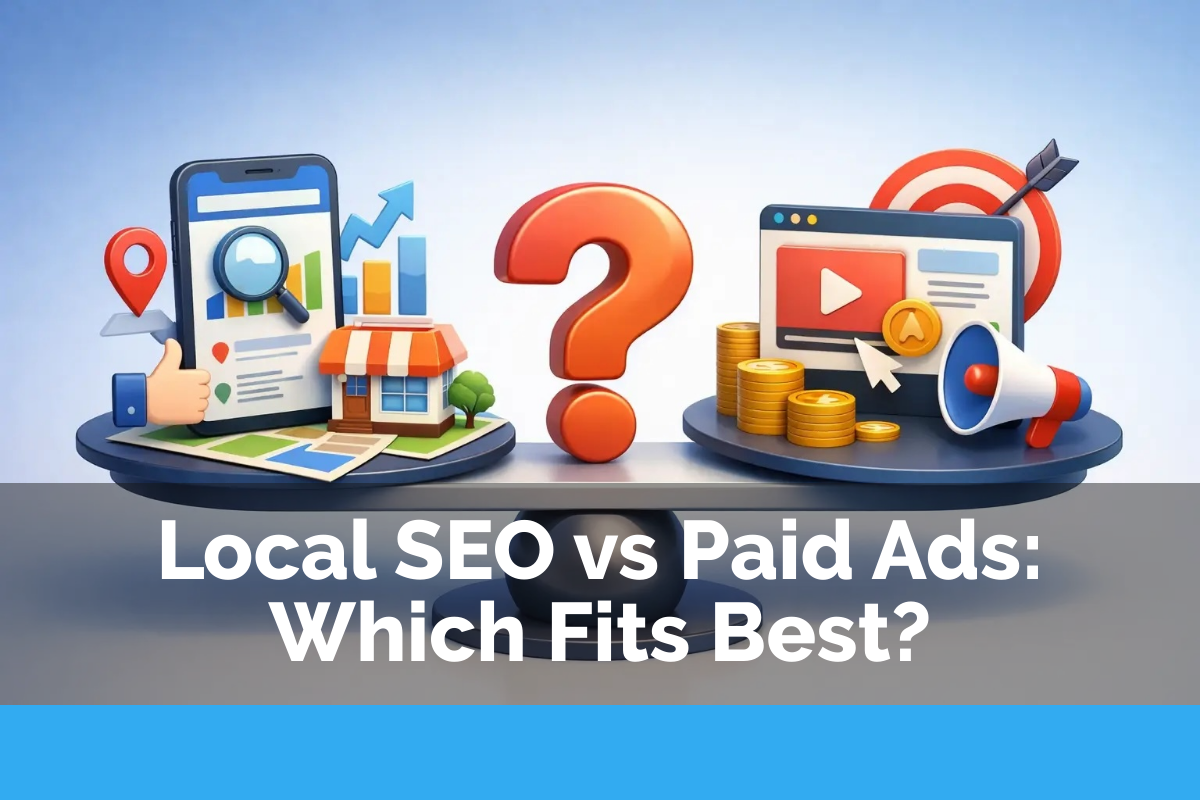
Local SEO vs Paid Ads: Which Fits Best?
A common situation for small business owners goes like this: you need more enquiries, you need them soon, and every marketing option seems to promise quick results. That is where the question of local SEO vs paid ads becomes so relevant. Both can help your business get found online, but they work in very different ways, and choosing the wrong one can waste time as well as budget.
If you run a local business, whether that is a salon, trades company, café, solicitor or independent retailer, the right choice depends less on what is fashionable and more on your goals, timeline and margins. There is no one-size-fits-all answer here. The stronger option is the one that matches how your customers search and how your business is set up to convert them.
Local SEO vs paid ads: the real difference
Local SEO helps your business appear in search results when people nearby are looking for the services you offer. That can include your Google Business Profile, map listings, location pages on your website and organic search rankings for terms such as “plumber in Leeds” or “wedding florist near me”.
Paid ads, on the other hand, put you at the top of search results or in social feeds because you are paying for that visibility. As soon as you stop funding the campaign, the visibility usually disappears.
That difference matters. Local SEO is more like building an asset. Paid ads are more like renting attention. Neither is automatically better. One gives you momentum over time, while the other gives you speed.
When local SEO makes more sense
For many UK small businesses, local SEO is the better long-term investment because it improves how visible you are in the places customers already look. If someone searches for a service in their area, they are often ready to act. They may call, request a quote or visit your premises within hours.
That is why local SEO can deliver highly qualified traffic. It is not just about getting more visitors to your website. It is about appearing at the moment someone nearby has a need and is comparing options.
Another benefit is staying power. A well-optimised website, accurate business listings, good reviews and useful local content can keep working for you month after month. You are not paying for each individual click, so your return can improve over time.
There is also a trust factor. Many users skip over ads and head straight to the map pack or organic listings because they see them as more established. If your business appears there with solid reviews and a professional website, you often start with more credibility.
That said, local SEO is not instant. It can take time to improve rankings, especially if your website is weak, your area is competitive or your Google Business Profile has been neglected. If you need leads next week, SEO alone may feel too slow.
When paid ads are the smarter choice
Paid ads are often the right move when speed matters. If you have launched a new service, opened in a new area or need enquiries quickly, they can start driving traffic almost immediately.
They also give you tighter control. You can choose the locations, times, audiences and search terms you want to target. That makes paid ads useful if you know exactly what service is most profitable and who you want to reach.
For example, a local emergency locksmith or boiler repair company may benefit strongly from paid search because customers need help right away. In that situation, appearing instantly at the top of results can generate calls that are worth far more than the ad spend.
Paid ads are also helpful for testing. Before investing heavily in SEO around a new service, you can use ads to see whether people search for it, click through and convert. That gives you quicker feedback than waiting months for organic rankings.
The drawback is cost and dependency. In competitive sectors, clicks can be expensive. If your landing page is poor or your offer is unclear, you can burn through budget without much to show for it. Paid ads work best when the website behind them is set up properly, with clear messaging, trust signals and an easy path to contact.
Local SEO vs paid ads for small budgets
If your budget is limited, the choice becomes more sensitive.
A lot of small businesses assume paid ads are easier because they are straightforward to switch on. That is true in one sense, but they can become expensive very quickly if they are not managed carefully. A few poorly targeted campaigns can cost more than fixing the foundations of your website and local presence.
Local SEO usually stretches a modest budget further over the long run. Improving your website speed, writing location-focused service pages, setting up or refining your Google Business Profile and collecting genuine customer reviews can all create value that lasts.
Still, small budget does not always mean SEO first. If your business has high-value leads and strong profit margins, a carefully managed paid campaign may produce a faster return. A wedding venue, private clinic or specialist legal service might justify the spend because one new client can cover a month of advertising.
The key question is not simply what costs less. It is what produces sustainable profit.
The hidden factor: your website
This is where many businesses come unstuck. They compare channels without looking at the destination.
If your website looks dated, loads slowly, lacks clear calls to action or does not reassure visitors, both local SEO and paid ads will underperform. More traffic does not fix a weak website. It only sends more people to a page that is not doing its job.
That is especially important for local businesses, because first impressions count. People are often comparing several businesses at once. If they click through and find a confusing or unprofessional site, they will simply move on.
A well-built website supports both strategies. It gives search engines clearer signals for SEO and gives paid visitors a better chance of converting. For many businesses, that foundation matters more than the channel they choose first.
A better question than which is best
Instead of asking whether local SEO or paid ads is better, it is often more useful to ask what job each one should do.
Local SEO is excellent for building visibility, trust and consistency in your local area. Paid ads are excellent for generating immediate attention and supporting short-term campaigns. Used together, they can be far more effective than either one alone.
A simple example is a local electrician. Paid ads can bring in urgent call-outs quickly. Local SEO can help the business rank for broader service terms over time, attract review-driven clicks and reduce reliance on ad spend later. One supports immediate demand, while the other builds long-term resilience.
This blended approach is often the most practical for growing businesses. You can use ads to create early momentum while your SEO foundation improves. Then, as organic visibility strengthens, you can become more selective with paid campaigns.
How to decide what fits your business
If you need leads quickly, paid ads may be the sensible starting point. If you want to reduce ongoing acquisition costs and build a stronger presence in your area, local SEO usually deserves priority.
If your market is highly competitive, expect both to require a proper strategy. If your service is niche or your location has lower competition, SEO may gain traction faster than you think. If your average customer value is high, ads may be easier to justify. If it is low, you need to be much more careful with every click.
It also depends on your internal capacity. Paid ads need monitoring and refinement. Local SEO needs consistency and patience. Neither channel works especially well when treated as a one-off task.
For many small businesses, the strongest route is to start with the essentials: a credible website, a clear Google Business Profile, properly structured service pages and a realistic view of budget. From there, you can choose whether to invest first in organic growth, paid reach or a measured mix of both. That is often where a partner such as LS25 Web Design can add real value – not by pushing one tactic, but by helping you choose what fits your business stage and goals.
The best marketing decision is rarely the one that sounds quickest or cheapest. It is the one that gives your business the right kind of visibility, at the right time, without leaving you dependent on guesswork.
Leave a Reply